Exhibition

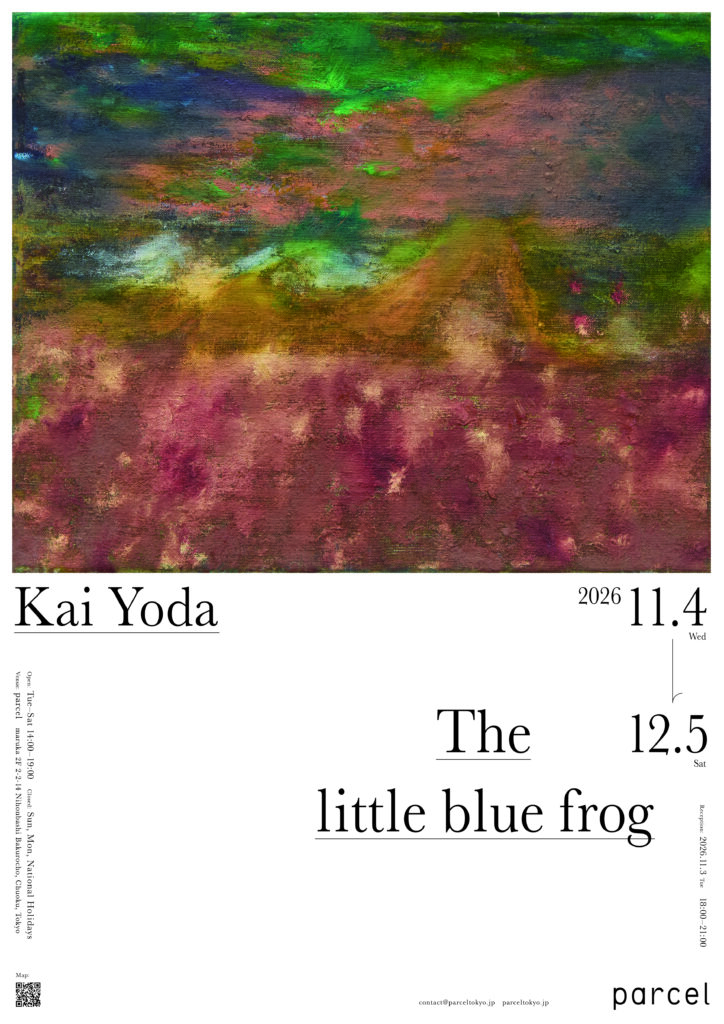
Current
2026
11.04Wed
12.05Sat
parcel
Open on Tue - Sat
14:00 - 19:00
Closed: Sun, Mon, National Holidays
Opening reception on November 3rd, Tue. 18:00-21:00
The little blue frog
Kai Yoda
details - JP
parcelでは、パリ、東京を拠点に活動するカイ・ヨダ(Kai Yoda)の個展「The little blue frog」を開催します。約10年にわたりヴァージル・イッタとのアーティスト・デュオ「Ittah Yoda」として国際的に作品を発表してきたヨダは、2024年以降、個人としての実践を本格的に展開しています。2026年夏にパリのBremond Capelaで開催されたフランス初個展「The Animal We Carry」に続き、本展は個人名義としては日本で初めての個展となります。
ヨダの関心は、親密さや欲望、そして私たちが言葉を与えるより前に抱えている動物的な本能といった、内側に埋もれた領域に向けられています。彼の絵画において、それらは記憶を形づくり、現実と想像の双方の地形を私たちが渡っていくための根源的な力としてあらわれます。刺すように鮮烈な色面を背景に、人とも動物ともつかないキメラ的な存在が立ちあらわれる画面は、見る者の記憶のどこかに触れながらも、ひとつの意味に定まることがありません。
その制作は、異なる方法でイメージを生み出しながら、そのあいだを行き来することで成り立っています。手描きのスケッチや日常の写真、美術史的な参照を複数のAIモデルに与え、無数の視覚的なヴァリエーションを生成。そのなかから特定のフレームを選び取り、リネンに油彩で描き起こしていく。人の手とアルゴリズムによる変容が対話を重ねるこのプロセスは、滑らかなデジタルの美学へと向かうものではありません。ヨダが自ら採取した顔料や埃、兎膠といった素材を画面に取り込みながら、掬い上げようとするのは、偶然や脆さ、不完全さ、そして物質そのものの痕跡です。ここでAIは完成像へ導くための道具ではなく、予期しない色彩や形態、連想を呼び込み、完璧さではなく不確かさを受け入れるための対話の相手として位置づけられています。
本展の中心となるのは、2025年5月より制作されている絵画シリーズ「Volo」です。ギリシャのパクソス島、フランスのキブロン、インドネシアのデポックでのアーティスト・イン・レジデンスにおける個人的で親密な経験に根ざしたこのシリーズでは、絵画的な身振り、AI、夢、そして複数の土地と時間をひとつの画面に重ね合わせる可能性が探られています。
シリーズにはまた、ガブリエル・ガルシア=マルケスの『百年の孤独』が深く影を落としています。一族の名が世代を越えて繰り返され、同じ運命が循環するこの小説のように、「レメディオス」「アマランタ」「ウルスラ」「ピラル」といった登場人物の名を冠した作品群は、特定の人物の肖像ではなく、心的・身体的・情動的な「存在」として画面に呼び出されます。避けがたく反復される歴史、過去に支配され続ける人々、曖昧に溶け合うアイデンティティ——小説が描く時間の複雑さが、ここでは絵画の時間へと置き換えられています。
パリでの初個展を経て生まれた本シリーズは、表現の幅をより伸びやかに広げ、さらなる自由さと実験性に満ちています。画面には手を使って描かれた立体的なワックスの層やテクスチャーが豊かに加わり、描画の力強さを増しています。作家本人の身の回りの人々や花、動物といった個人的なモチーフや、空間を漂う海洋生物のような存在とその浮遊感は変わらず存在しながらも、そこに各地でのレジデンスで目にした街や人々、個人的な体験の断片や摩擦、そして集合的記憶が多層的に刻み込まれます。本展ではそれらを混ぜ合わせることで生まれたシーンに視覚の枠を超え、身体感覚を通して没入する新たなアプローチを試みているのです。
ヨダはかつて、特定の何かには見えず、それでいて「全く何にも見えないわけでもない」——そのバランスこそが重要だと語っています。見慣れたものと見知らぬもののあいだで揺れ続けるその感覚は、現在の絵画にも確かに受け継がれています。また、作品を「自分ひとりのもの」とする考え方に違和感を抱き、意図的に他者のアイデアを制作に招き入れてきたヨダは、個人の実践においても、料理人、サウンド・アーティスト、調香師、レザー作家など多様な協働者とともに、鑑賞体験を視覚の外側——触覚や嗅覚、身体の記憶——へと押し広げています。
環境情報学、写真、映像を学んだヨダにとって、イメージとは目に見えないエネルギーを宿し、繰り返し立ち返るための場所でもあります。自然と人工、構築されたものと本能的なもの、生きているものとつくられたもの。ヨダはエコロジーを描かれるべき主題としてではなく、相互依存を考えるための方法として捉え、それらが共存するひとつの環境を立ち上げます。人間と動物、まなざしと感覚の境界がほどけはじめる、その繊細な接触の領域へ。本展は、日本の観客がヨダの個人としての絵画実践にまとまったかたちで触れる、はじめての機会となります。
また、本展に併せて、カイ・ヨダと磯谷博史が国分寺の「the glass house」で企画するグループ展「星の友情」の一部作品をサテライト展示いたします。「星の友情」は、ヨダ自身の幼少期の記憶が刻まれた父親の写真スタジオを舞台に、フランスと東京を拠点とするアーティストたちが集い、場所や世代、文化的背景を越えた対話と交流を生み出すプロジェクトです。本企画には、マチルダ・アルブイ、アポリナリア・ブロッシュ、トルニケ・ロバキゼ、ジョゼファ・ンタム、南川史門、菊池奈緒、岡田理、与田弘志の8名が参加します。
「星の友情」
会期:11月21日(土)– 12月13日(日)※週末のみ開廊予定
オープニングレセプション:11月20日(金)※招待者・関係者のみ
会場:the glass house 国分寺市本多1-12-16
共同キュレーション:磯谷博史、カイ・ヨダ
details - EN
parcel is pleased to present The little blue frog, a solo exhibition by Kai Yoda, an artist based between Paris, London, Tokyo, and Stockholm. For around a decade, Yoda exhibited internationally as one half of the artist duo Ittah Yoda with Virgile Ittah; since 2024, he has been developing a personal artistic practice. Following The Animal We Carry at Bremond Capela, Paris, in summer 2026—his first solo exhibition in France—this will be his first solo exhibition in Japan as Kai Yoda.
Yoda’s practice turns toward buried interior territories: intimacy, desire, and the animal instincts we carry before we are able to name them. In his paintings, these emerge as fundamental forces that shape our memories and our navigation of both real and imagined topographies. Set against acidic grounds, chimeric figures—neither quite human nor quite animal—touch something in the viewer’s memory while refusing to settle into a single meaning.
His process moves between several ways of producing images. Hand-drawn sketches, everyday photographs, and art-historical references are fed into a range of AI models that generate numerous visual iterations. From these, Yoda selects specific frames and translates them into oil on linen. Yet this dialogue between the human hand and algorithmic transformation deliberately resists a smooth digital aesthetic. Incorporating materials such as self-collected pigments, dust, and rabbit-skin glue, Yoda seeks out traces of accident, fragility, imperfection, and matter. AI functions here not as a route to a finished image, but as an interlocutor that invites unexpected colors, forms, and associations—a way of embracing uncertainty rather than perfection.
At the core of the exhibition is *Volo*, a series of paintings begun in May 2025. Rooted in personal and intimate experiences during residencies in Paxos, Quiberon, and Depok, the series explores the interplay between pictorial gesture, artificial intelligence, dreams, and the possibility of merging multiple geographies and temporalities within a single painting. It is also informed by Gabriel García Márquez’s One Hundred Years of Solitude. As in the novel, where names recur across generations and fates circle back upon themselves, works bearing the names of its characters—Remedios, Amaranta, Úrsula, Pilar—are not portraits of specific individuals but summon mental, physical, and emotional presences. The novel’s blurred identities and temporal loops—the inescapable repetition of history, and protagonists governed by their past—become a source for the time of painting itself.
Born after his first solo exhibition in Paris, this series expands his range of expression with greater ease, and is full of new freedom and experimentation. Three-dimensional layers and textures of wax, at times painted by hand, enrich the surfaces and strengthen the force of the painting. Personal motifs remain, such as people close to the artist, objects such as flowers, and animals, as do beings reminiscent of marine life drifting through space, with their sense of weightlessness. Layered onto these are the towns and people he encountered during his residencies, fragments of personal experience and friction, and collective memory. In this exhibition, Yoda attempts a new approach in which the scenes created by mixing these elements go beyond the visual and immerse viewers through bodily sensation.
This practice also extends questions that ran through Ittah Yoda. Combining technologies such as VR, 3D modeling, and AI with organic materials including phytoplankton, hand-blown glass, beeswax, and scent, the duo created polysensory installations envisioning a world in which the natural and the digital interweave and co-evolve. Yoda has spoken of seeking forms that resemble nothing in particular, yet are never quite nothing at all—a delicate balance that continues to animate his paintings today. Long uneasy with the idea of a work belonging to one author alone, he has deliberately invited others’ ideas into his process; in his solo practice, too, collaborations with chefs, sound artists, perfumers, and leather makers extend the experience of the work beyond sight, toward touch, smell, and the memory of the body.
With a background spanning environmental information, photography, and moving image, Yoda understands images as vessels that hold imperceptible energies while serving as sites of return. The natural and the fabricated, the constructed and the instinctive, the living and the made: rather than depicting ecology as a theme, Yoda treats it as a way of thinking through interdependence, building an environment in which these can coexist. Opening onto a delicate threshold where the boundaries between human and animal, looking and feeling, begin to loosen, the exhibition offers audiences in Japan their first extended encounter with Yoda’s individual painting practice.
In conjunction with this exhibition, PARCEL will also present a series of works from Star Friendship, a group exhibition organized by Kai Yoda and Hirofumi Isoya at the glass house in Kokubunji, Tokyo. Set in the former photography studio of Yoda’s father, a place deeply connected to his childhood memories, Friendship of Stars brings together artists based in France and Tokyo, fostering dialogue and exchange across places, generations, and cultural backgrounds. The exhibition features eight artists: Mathilda Albuoy, Apollinaria Broche, Tornike Robakidze, Josèfa Ntjam, Shimon Minamikawa, Nao Kikuchi, Shizuka Okada, and Hiroshi Yoda.
Star Friendship
Dates: November 21 (Sat) – December 13 (Sun), 2026 *Open on weekends only
Opening Reception: November 20 (Fri), 2026 *By invitation only
Venue: the glass house 1-12-16 Honda, Kokubunji, Tokyo, Japan
Co-curated by: Hirofumi Isoya and Kai Yoda
展覧会、各作家、作品等に関するお問い合わせはcontact@parceltokyo.jp までお願いいたします。
For further information regarding this exhibitions or the artists, artworks please contact us at contact@parceltokyo.jp
Kai Yoda
Kai Yoda(カイ・ヨダ)は1985年東京生まれ。2006年に慶應義塾大学環境情報学部を卒業後、2011年に英国ロイヤル・カレッジ・オブ・アート(RCA)の写真・映像専攻(MFA)を修了。現在はパリ、東京を拠点に活動している。
RCA在学中にヴァージル・イッタ(Virgile Ittah)と出会い、共同制作を開始。2015年にアーティスト・デュオ「Ittah Yoda」を結成し、約10年間にわたり作品を発表した。
Ittah Yodaは、多様な文化的背景を活かし、仮想世界の構築と広範な素材研究を組み合わせた多感覚的なインスタレーションを制作。有機的な形状や素材を取り入れ、仮想現実や情報技術によって時間を超えた彼らの彫刻、絵画、インスタレーションは、様々なコラボレーションを通じて開発され、環境からの「遺伝的・芸術的」情報を体現し共有する形で展開された。
2024年以降、カイ・ヨダは個人での芸術的実践を本格化させている。彼の実践において焦点となるのは、親密さや欲望、そして私たちが言葉を与える前に抱いている動物的な本能など、内奥に埋もれた領域である。有機顔料、自作の天然顔料、蜂蝋、お香、レザー、倒木などの自然素材を使用した彼の絵画では、これらの要素が根源的な力としてあらわれ、私たちの記憶を形作り、現実と想像上の地形の両方をナビゲートする。さらに、制作途中の絵画と日常の写真を組み合わせるAIとの対話を通して、完璧さではなく不確実性を受け入れながら無意識のイメージや連想を探求し、制作の新たなステップへと繋げている。
作品は、FRAC des Pays de la Loire(フランス)、Château La Coste(フランス)、Sigg Art Foundation(スイス)、Misk Foundation(サウジアラビア)、Tumurun Museum(インドネシア)などの主要なパブリックコレクションに収蔵されている。
Kai Yoda was born in Tokyo in 1985. After graduating from the Faculty of Environment and Information Studies at Keio University in 2006, he completed his Master of Fine Arts (MFA) in Photography at the Royal College of Art (RCA) in the UK in 2011. He is currently based in Paris and Tokyo.
While at the RCA, he met Virgile Ittah and began collaborating. In 2015, they formed the artist duo “Ittah Yoda” and presented works together for over a decade. Drawing on their diverse cultural backgrounds, Ittah Yoda created multisensory installations that combined the construction of virtual worlds with extensive material research. Incorporating organic forms and materials, their sculptures, paintings, and installations were developed through various collaborations involving virtual reality and information technology. Together, these works expanded to embody and share “genetic and artistic” information drawn from the environment.
Since 2024, Kai Yoda has been working independently. The central focus of his work lies in subterranean, hidden realms — intimacy, desire, and the animalistic instincts we hold before language gives it name. In his paintings, which employ natural materials such as organic pigments, homemade natural dyes, beeswax, incense, leather, and fallen trees, these elements emerge as primal forces that shape our memories and navigate both real and imagined terrains. Through an ongoing dialogue with AI by combining works-in-progress with everyday photographs, he explores unconscious imagery and associations while embracing uncertainty over perfection, leading his practice into new territory.
His works are included in major public collections, including FRAC des Pays de la Loire (France), Château La Coste (France), the Sigg Art Foundation (Switzerland), the Misk Foundation (Saudi Arabia), and the Tumurun Museum (Indonesia).