News
一覧へ戻る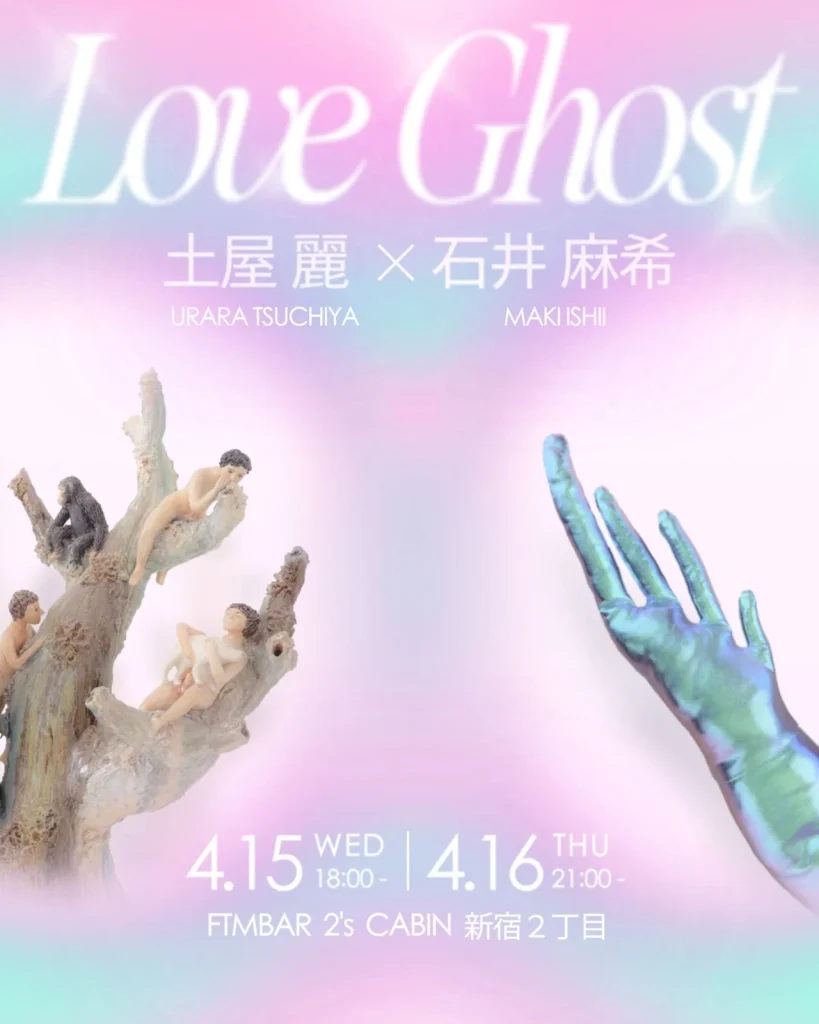
2026
04.15Wed
2026
04.16Tue
FTM BAR 2's CABIN 新宿二丁目店
April 15th 18:00-21:00
(Works will remain viewable after 21:00, but the bar will operate as usual.)
April 16th 21:00-4:00 (Works will be viewable.)
Drink order required.
The works can also be viewed at FTM BAR 2’s CABIN Tokyo.
details - JP
土屋麗は、緻密に構築されたセラミックをはじめ、没入型インスタレーション、衣装、パフォーマンス、映像など、多岐にわたる表現活動を展開している。その作品世界において織り交ぜられているのは、衝動的なパフォーマンスが持つ気まぐれな瞬間性と、窯での制作が要求する計算された忍耐という長期的なプロセスだ。ナチュリスト・サウナやうらぶれたホテルの一室、マッチングアプリ上のやり取りなど、日常のあらゆる断片にインスピレーションを見出し、観る者の意表をつき、翻弄するような没入型の空間を作り出す。
また、自身の生活体験やアーティスト仲間との交流、テレビ番組やポップカルチャーから引用したナラティブを取り込み、キッチュの転覆と「居心地の悪さ」の境界線を押し広げることに関心を寄せている。遊び心と無邪気さを装いながらも、現代の人間関係に潜む緊張や、根強く残る家父長制的構造に切り込むその手法は、個人的な領域と社会的な領域の間に生じる断絶を浮き彫りにしている。
4月15日(土)、16(日)にFTM BAR 2’s CABIN 新宿二丁目店にて 土屋麗と石井麻希による展覧会「Love Ghost」を開催いたします。
本展の舞台は、新宿二丁目という東京のクィアカルチャーの中心地に位置する、希少なFTMバーです。両作家はこれまで、日常的なモチーフを手がかりに、既存の社会構造や意味、それらを支える関係性について問い直してきました。
本展では、身体やセクシュアリティを示唆する日常的なモチーフを用い、通常は消費や交流の場であるバー空間を展示空間へと転換します。それにより、身体やセクシュアリティをめぐる感覚や関係性の揺らぎを浮かび上がらせます。
展覧会詳細はこちらをご参照ください。
details - EN
Urara Tsuchiya and Maki Ishii present “Love Ghost,” an exhibition taking place on April 15th (Sat) and 16th (Sun) at FTM BAR 2’s CABIN, Shinjuku Ni-chome.
Set within a rare FTM bar in the epicenter of Tokyo’s queer culture, the exhibition builds upon the artists’ ongoing exploration of social structures and their underlying meanings through the lens of the everyday. By introducing motifs evocative of bodily existence and sexuality, the artists repurpose the bar—traditionally a site of consumption and social exchange—into a space for reflection. This transformation highlights the shifting perceptions and fluid relationships that define our understanding of the body and sexuality.
Please click here for more details about the exhibition.
土屋 麗 | Urara Tsuchiya
1979年 日本、大阪生まれ。グラスゴーを拠点に活動しています。
土屋の作品は、陶芸、パフォーマンス、ビデオなど、さまざまなメディアを含んでいます。明快なモチーフを手描きした陶磁器で知られており、シュールレアリスムと日常、ユーモアと奇妙さの間の空間を探求しています。
作品の中では、動物と人間、大人と赤ちゃんなど、異なる概念の境界線を遊び心を持って扱い、非凡でユーモラスな効果を生み出しています。土屋は衣装や詩、家庭料理を小道具として使用し、代替の環境と行動の形を構築し、観客に自身の身体と個人的な境界を探索させます。
土屋はグラスゴー美術学校でMFAを取得し、ロンドンのゴールドスミス大学で美術を学びました。彼女の作品は、Frieze London(イギリス)、Glasgow International(イギリス)、Trade Gallery(イギリス)、Union Pacific(イギリス)などの注目の展覧会で展示されています。
Urara Tsuchiya (b. 1979 Osaka, Japan) lives and works in Glasgow.
Her works encompass various mediums including ceramics, performances, and videos. Tsuchiya is renowned for her hand-painted ceramics with explicit motifs, which explore the space between surrealism and the ordinary, as well as humor and strangeness.
In her art, Tsuchiya plays with boundaries between different concepts, such as animal/human and adult/baby, to create unusual and humorous effects. She employs costumes, poetry, and home cooking as props to construct alternative environments and forms of behavior while pushing the viewer to navigate their own physical and personal boundaries.
Tsuchiya holds an MFA from Glasgow School of Art and has studied Fine Art at Goldsmiths University in London. Her works have been displayed at notable exhibitions such as Frieze London (UK), Glasgow International (UK), Trade Gallery (UK), and Union Pacific (UK). She is set to showcase upcoming exhibitions at Ada Projects (IT) and a group show at Vestfossen Kunstlaboratorium (NO).
石井 麻希 | Maki Ishii
石井の作品はアイデンティティの不確実性やメディアの役割への批評的な視点をもとに、映像やインスタレーションを通じて、人間と「他者」との関係を探求しています。動物や自然環境といった「非人間」の視点を作品に取り込もうとする実験的なアプローチは私の制作の核をなしており、そのプロセスで協働する動物コミュニケーターとの対話もまた、作品の重要な一部を形成しています。
これらの作品は人間中心主義を超えた視野をもたらすとともに、日常における「観察」という行為そのものを問い直すものです。私たちが社会的・文化的に構築してきたアイデンティティやコミュニケーション、消費社会の枠組みを改めて見つめ直すことで、見慣れた風景の背後に潜む異質な存在の気配へと、静かに目を向けます。
Based on a critical perspective on the uncertainty of identity and the role of media, Maki Ishii explores the relationship between humans and “the other” through video and installation. An experimental approach that seeks to incorporate the perspectives of “non-humans,” such as animals and the natural environment, lies at the core of her practice. The dialogues with animal communicators throughout this collaborative process form an integral part of the work.
These works offer a vision that transcends anthropocentrism and calls into question the very act of “observation” in everyday life. By re-examining the frameworks of identity, communication, and consumer society that we have socially and culturally constructed, Ishii quietly draws our attention toward the presence of the “alien” or the “other” lurking behind familiar landscapes.